
In a kitchen, gloves protect the food as much as the hands. This guide to the best gloves for kitchens and food handling matches food service tasks to a glove that suits them, for restaurants, caterers, central kitchens and food manufacturers.
What matters in food handling
- Cross-contamination. A glove that has touched raw meat carries the same bacteria as a bare hand. Gloves must be changed between raw and ready-to-eat food.
- Hand washing still comes first. Food safety regulators treat gloves as one way to avoid touching ready-to-eat food, alongside tongs, and not as a replacement for washing hands (Food Standards Australia New Zealand: advice for food handlers).
- Wet work. Frequent contact with water, food and cleaning products is a common cause of dermatitis in catering.
- Latex allergy. Natural rubber latex proteins can cause allergic reactions, so non-latex gloves are preferred for food handling (HSE: choosing the right gloves).
- Glove fragments. Blue gloves are widely used in food production because blue is easy to spot if a piece tears off.
What the research says
Findings from safety regulators and published studies, mostly from Australia, the UK and the US.
- Gloves can make hygiene worse if they replace hand washing. In a US restaurant observation study, workers wearing gloves attempted to wash their hands about half as often as those without (Green and others, J Food Prot).
- US food workers washed their hands only about one time in three when they should have. Where a food worker was linked to an outbreak, hands were the route about nine times in ten (CDC EHS-Net).
- About 90% of raw retail chicken samples in three Australian states carried Campylobacter (Walker and others). In kitchen tests, a share of it moved from chicken to hands, and from hands to ready-to-eat food (Luber and others).
- On one long task, change gloves at least every four hours (Oregon Health Authority).
- Disposable gloves are single-use items. They cannot be sanitised and reused (Safe Food Australia).
- Use brightly coloured waterproof dressings on cuts, so a lost dressing is easy to spot in food (UK Food Standards Agency).
- Having wet hands, or wearing gloves, for more than two hours a shift counts as wet work, the leading cause of irritant dermatitis in long-term Australian clinic data. A cotton liner under the glove reduces sweating (ASCC wet work guidance).
Which glove for which kitchen task
| Task | What the glove must do | Bergamot option | Datasheet (PDF) |
| Food preparation, raw meat, fish and poultry | Strong, close-fitting, latex-free, easy to see | SE Nitrile Powder Free Examination Gloves, or MaxProtect Nitrile Powder Free Examination Gloves (MaxProtect is more durable and widely used in food contact settings) | Download SE Nitrile Download MaxProtect |
| Serving, sandwich making, bakery and counter work | Loose-fitting, quick to change many times a shift | HDPE Gloves, or CPE Disposable Gloves | Download HDPE Download CPE |
| Short, light tasks and front-of-house cleaning | Economical, latex-free | Vinyl Powder Free Examination Gloves | Download Vinyl |
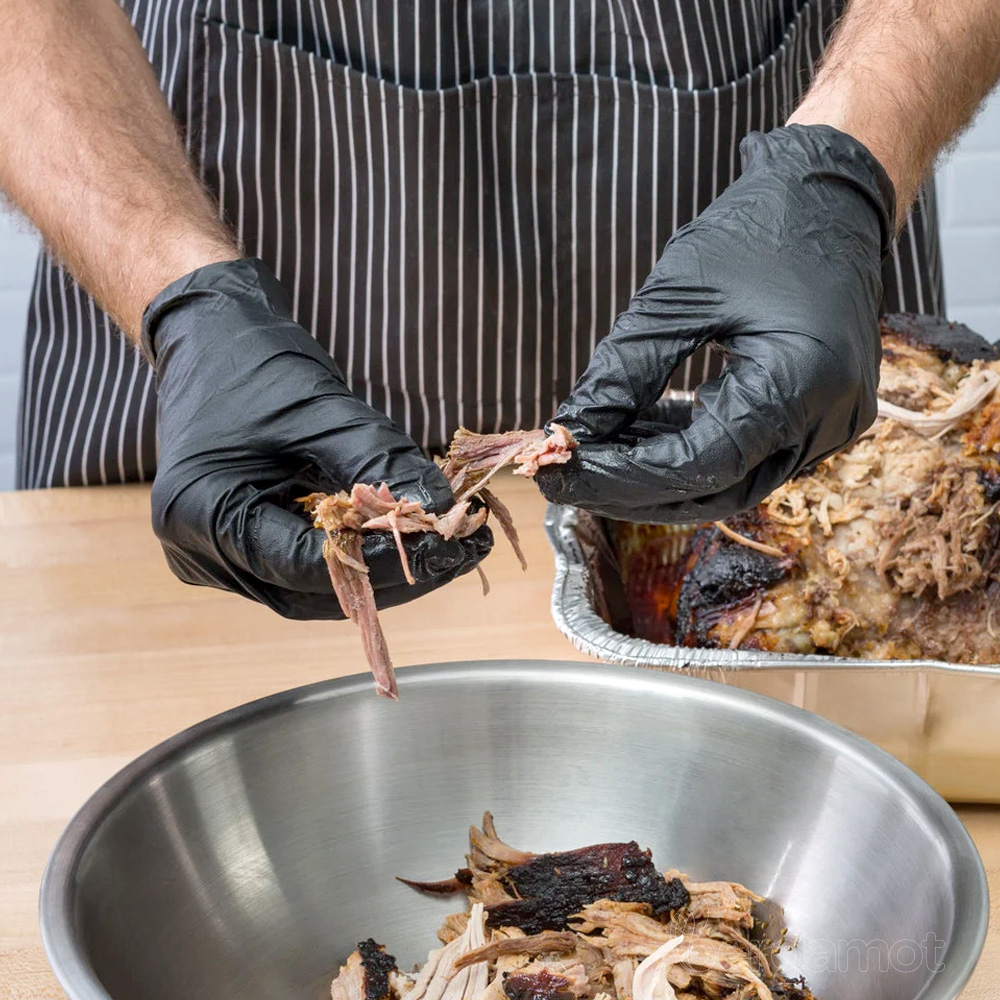
| Oily, greasy and heavy prep; cleaning fryers and grills when cool | Grip on greasy surfaces and resistance to tearing | Grip-X Nitrile Powder Free Gloves (Black), or Grip-X Nitrile Powder Free Gloves (Orange) A heavy-duty nitrile glove with a diamond-textured grip. | Download Grip-X Black Download Grip-X Orange |
| Dishwashing and kitchen cleaning | Reusable, longer cuff for wet work | Household Latex Flock Lined Rubber Gloves (contains natural rubber latex) | Ask us |
| Cleaning with concentrated sanitisers and degreasers | Chemical splash protection | ChemTough Nitrile Powder Free Examination Gloves | Download ChemTough |
ChemTough gloves are SIRIM registered.
Disposable gloves are not heat protection. Use heat-rated gloves for hot trays, pans and fryers.
Ask us for food-contact test reports for the gloves you plan to use.
Six glove habits for food handlers
- Wash and dry hands before putting gloves on, and again when changing them.
- Change gloves between raw and ready-to-eat food.
- Change gloves after touching your face or hair, handling rubbish, cleaning, or using the toilet.
- Change gloves that are torn or have been worn for a long task.
- Never wash and reuse disposable gloves.
- Cover cuts with a waterproof dressing under the glove.
Getting the size right
A glove that is too tight tears and tires the hand; one that is too loose snags and loses grip. Measure across the palm just below the knuckles. Standard palm widths for nitrile examination gloves (ASTM D6319) are S 80 mm, M 95 mm, L 110 mm and XL 120 mm (each ±10 mm). When buying for a team, ask each person for their size.
Buying for a restaurant group, caterer or food manufacturer
In Malaysia, the Food Hygiene Regulations 2009 set the hygiene duties for food premises and food handlers. Bergamot is a Malaysian glove supplier, supplying food handling gloves wholesale by the carton to restaurants, hotels, central kitchens and food manufacturers, with private-label packing for importers.
Contact us, email info@bergamot.com.my or WhatsApp +6012 714 4186 for samples, specifications and bulk pricing.
Frequently asked questions
What gloves are best for food handling?
Blue nitrile gloves are the most common choice for food preparation because they are strong, latex-free and easy to see. Polyethylene (HDPE or CPE) gloves suit serving and quick tasks where gloves are changed constantly.
Are nitrile gloves food safe?
Nitrile gloves made and tested for food contact are. Ask your supplier for the food-contact test report for the specific glove.
Nitrile or vinyl gloves for a kitchen?
Nitrile is stronger and resists oils and fats better, so it suits prep work. Vinyl costs less and suits short, light tasks.
How often should food handlers change gloves?
At every point where you would otherwise wash your hands: between raw and ready-to-eat food, after touching anything dirty, and whenever a glove is torn.
More glove guides by trade
- Gloves for mechanics
- Gloves for panel beaters and spray painters
- Gloves for car detailers
- Gloves for plumbers
- Gloves for concreters and tilers
- Gloves for carpenters and builders
- Gloves for painters and decorators
- Gloves for cleaning and pest control
General information only. Follow the safety data sheet and label of the products you use and your local workplace safety regulations.